Fine-tuning services
A model that already knows your business.
We fine-tune open-weight models on your data so they follow your format, use your vocabulary and run faster and cheaper than a general model. Then we prove it with numbers.
Why fine-tune
When prompting is not enough.
Fine-tuning is not always the answer. We will tell you when a good prompt and a knowledge base will do, and when a trained model will pay for itself.
Consistency
Exact output formats, house style and domain terms, every time, without a page of instructions.
Lower cost
A small tuned model can match a large general one on a narrow task, at a fraction of the price per call.
Speed
Smaller models answer faster, which matters on a phone call or inside a busy workflow.
Privacy
Run the model in your own cloud or on-premises, so sensitive data never leaves your control.
How it works
Measured from the first day.
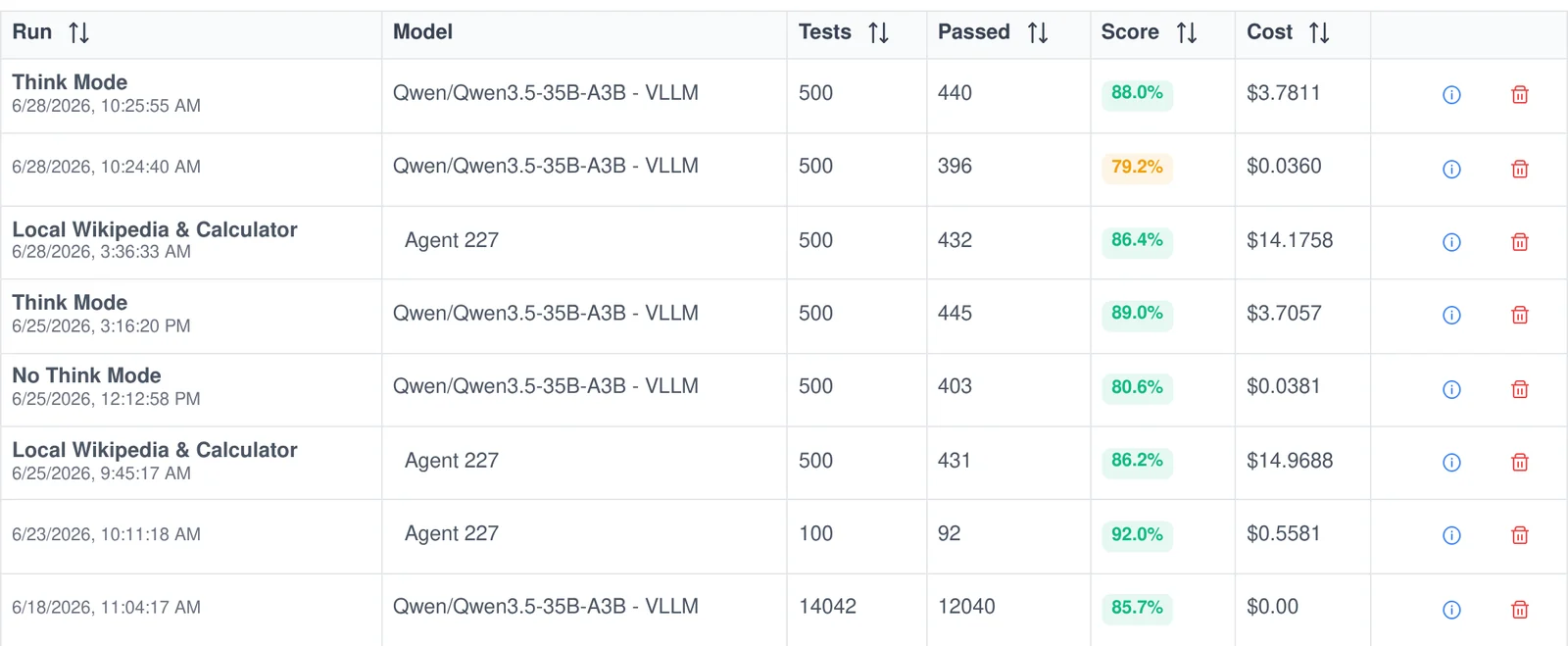
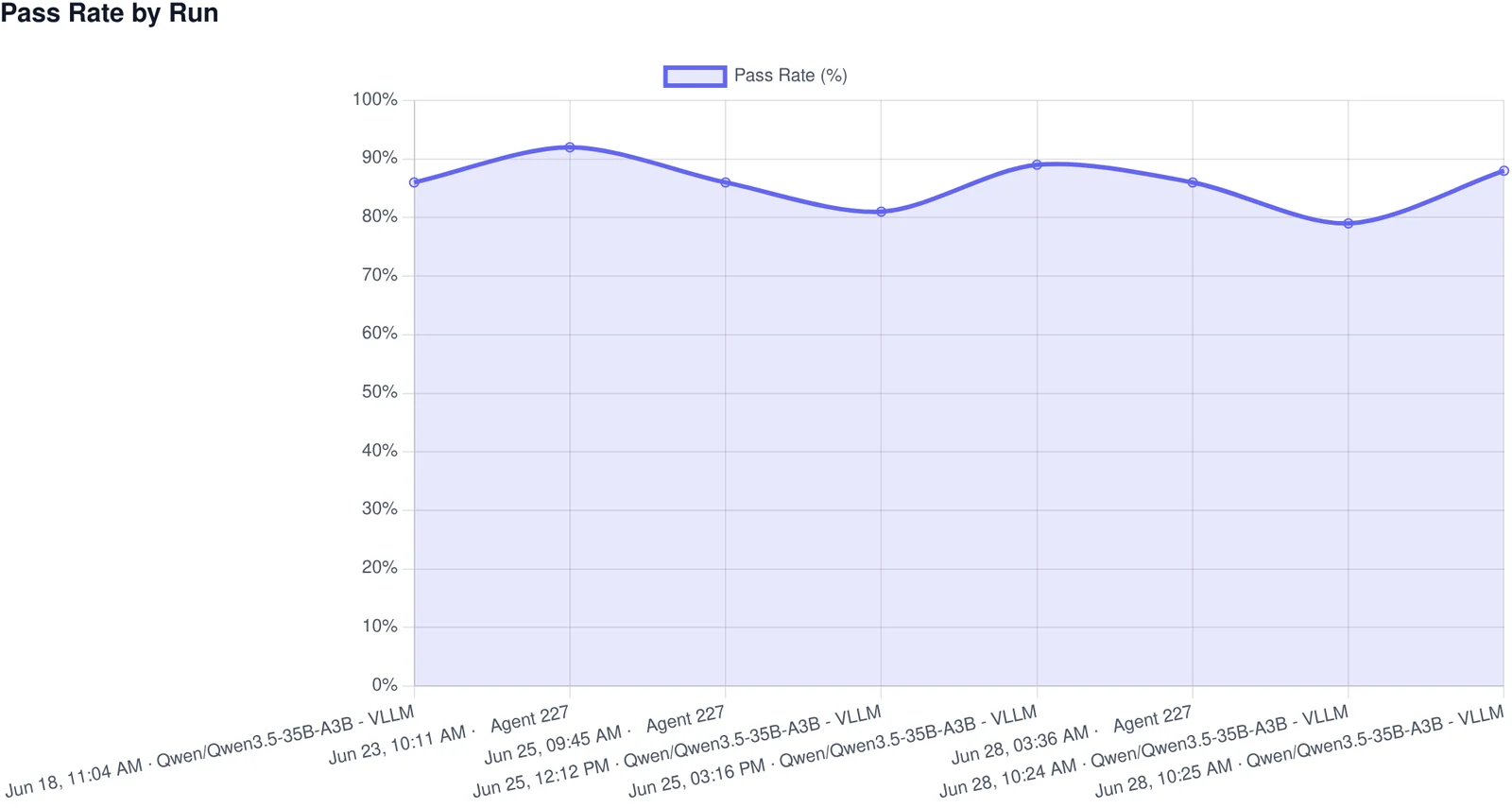
The evaluation set comes before the training run. That way “better” has a number attached, and so does “good enough.”
Audit
We review your data, define the task and write the evaluation set with your experts.
Week 1Baseline
Leading general models are scored on that set, so we know the bar the fine-tune has to beat.
Week 2Train
Dataset cleaning and synthesis, then LoRA or full fine-tuning runs, compared side by side.
Weeks 2–5Ship
The winning model is deployed behind your agent or API, with automated re-evaluation on a schedule.
Week 6
What we fine-tune
Tasks that suit a trained model
- Classification and routing: tickets, emails, leads, documents
- Extraction into structured data from forms, specs and résumés
- Drafting in a fixed voice: replies, listings, reports, notes
- Tool-calling agents that must follow a strict procedure
- Domain question answering with your terminology
- LoRA / QLoRA
- Full fine-tuning
- Preference tuning
- Distillation
- Synthetic data
- Open-weight models
What you receive
Deliverables
| Item | What it is |
|---|---|
| Model weights | The trained model, yours to keep and run anywhere the license allows. |
| Evaluation report | Baseline vs fine-tuned scores, cost and latency per call, failure examples. |
| Dataset | The cleaned, versioned training and test sets, documented. |
| Deployment | Hosted endpoint in your cloud, on-premises or with us, plus monitoring. |
| Model card | Intended use, limits, data sources and the retraining plan. |
An inbox classifier that learns your folders.
A recruiting team files thousands of emails a week into a dozen folders. A general model gets most of them right but is slow and costly at that volume. Here is how a fine-tune would be judged.
- Label a sampleTwo thousand past emails with the folder a person chose, split into training and test sets.
- Score the baselineRun a general model on the test set and record accuracy, latency and cost per thousand emails.
- Train and compareFine-tune a small open-weight model; it ships only if it matches or beats the baseline on accuracy.
- Keep it honestRe-score monthly on fresh mail; retrain when new folders or patterns appear.
FAQ
Fine-tuning questions
How much data do we need?
For many narrow tasks, a few hundred to a few thousand good examples. We check what you have in the audit and can generate synthetic examples to fill gaps.
Will our data be used to train anyone else’s model?
No. Your data trains your model only, and we can do all the work inside your own cloud account.
Which base models do you use?
Open-weight models whose licenses allow commercial use, chosen per task. We list the license terms in the model card.
What if the fine-tune does not beat the baseline?
Then you keep the evaluation set and the baseline results, and we recommend the cheaper route. That outcome is agreed before training starts.
Start a project
Got a task a model keeps getting wrong?
Send us an example or two. We will tell you whether fine-tuning, better prompting or a knowledge base is the right fix.
New projectssales@turing-labs.comSupport for clientssupport@turing-labs.com